



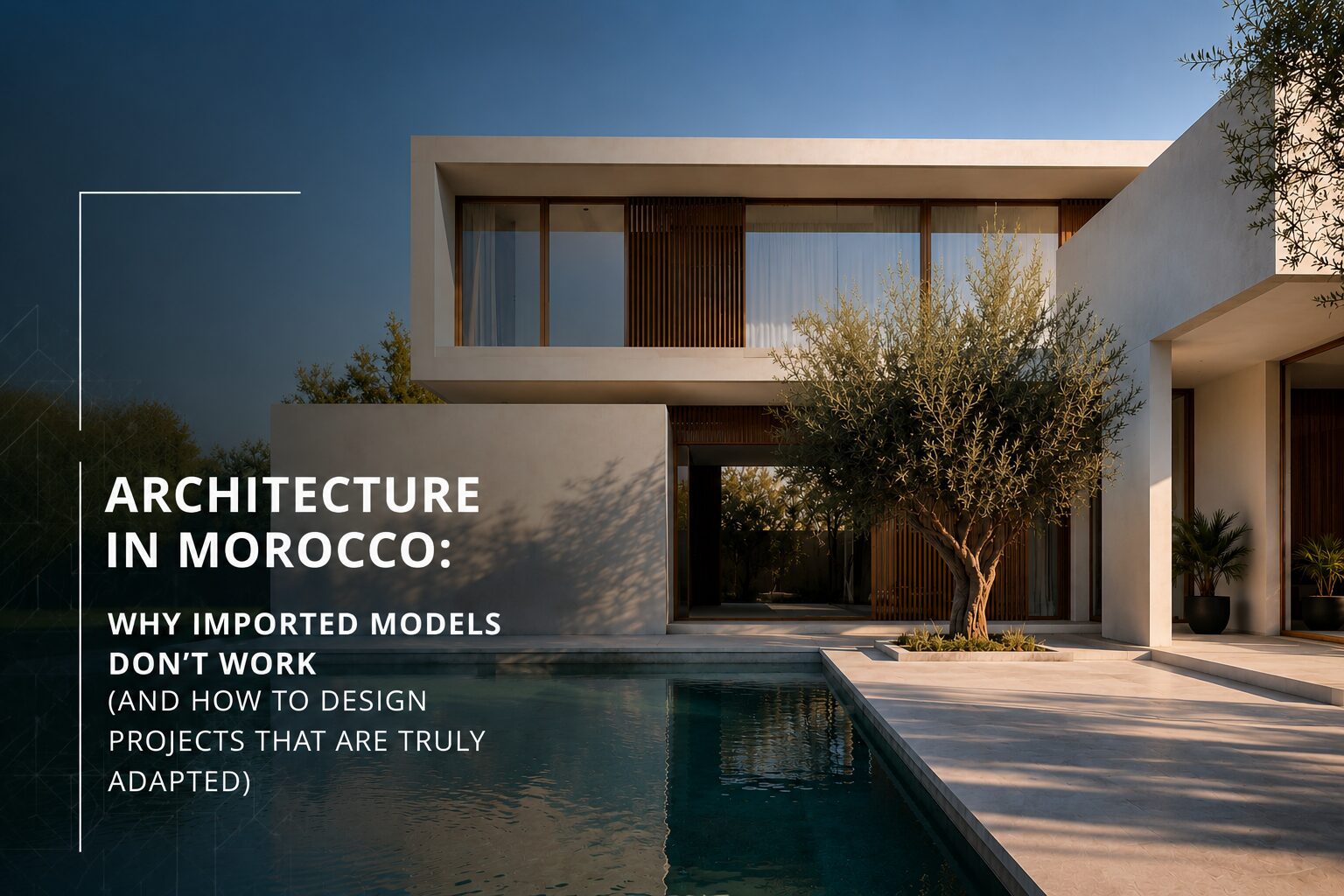
Architecture in Morocco: why imported models don’t work (and how to design adapted projects)
L’architecture au Maroc connaît depuis plusieurs années une profonde transformation. Entre urbanisation rapide, ouverture internationale et évolution des modes de vie, de nombreux projets résidentiels, commerciaux et institutionnels adoptent aujourd’hui des références architecturales venues d’Europe, du Golfe ou d’Amérique du Nord. Cette influence internationale a permis l’émergence de nouvelles écritures contemporaines et de nouvelles méthodes de conception. Pourtant, dans de nombreux cas, ces modèles importés montrent rapidement leurs limites lorsqu’ils sont appliqués sans adaptation au contexte marocain.
Concevoir un projet architectural au Maroc ne consiste pas uniquement à reproduire une esthétique ou une tendance internationale. L’architecture marocaine possède des réalités climatiques, culturelles, urbaines et sociales spécifiques qui influencent directement la manière d’habiter, de travailler et de vivre les espaces. Lorsqu’un projet ignore ces paramètres, le résultat peut devenir incohérent, inconfortable ou déconnecté de son environnement.
Today, the role of the architect in Morocco goes far beyond simply producing an aesthetically pleasing building. It involves designing spaces capable of meeting local needs, climatic constraints, and contemporary expectations, while integrating new requirements for comfort, sustainability, and performance.
L’importance du contexte dans l’architecture au Maroc
One of the main errors observed in some recent projects is the direct importation of foreign architectural models without any real adaptation to the Moroccan context. A project designed for a European or North American climate cannot be replicated as is in a city like Rabat, Marrakech, Agadir, or Tangier.
Le Maroc possède une diversité climatique importante. Entre les régions atlantiques, les zones montagneuses, les villes désertiques ou les zones fortement ensoleillées, les contraintes environnementales changent considérablement. La gestion de la chaleur, de l’ensoleillement, des vents ou de l’humidité devient alors un élément fondamental de la conception architecturale.
Traditional Moroccan architecture has historically addressed these issues with ingenuity. Patios, thick walls, carefully placed openings, and enclosed spaces naturally created thermal comfort and preserved family privacy. These principles remain highly relevant in contemporary Moroccan architecture today.
A successful architectural project therefore does not consist of opposing tradition and modernity, but of creating a coherent dialogue between the two.
Why some international models fail in Morocco
In several Moroccan cities, projects are being developed that replicate international models without considering local needs. This standardization can create visually spectacular buildings, but they are often poorly suited to the daily lives of their users.
Fully glazed villas are a common example. While this type of architecture may work in some temperate climates, it often becomes problematic in Moroccan cities with high sun exposure. Without adequate shading, these spaces generate significant overheating and drastically increase the need for air conditioning.
The same observation applies to certain open spaces inspired by Western models. Lifestyles in Morocco maintain a particular relationship to privacy, the hierarchy of spaces, and the separation between private and reception areas. Ignoring these cultural dimensions can result in spaces that are uncomfortable to live in, despite their aesthetic appeal.
Architecture in Morocco must therefore avoid the effect of copying and favour a contextual approach, capable of understanding the specificities of the territory and its uses.
Designing architecture adapted to Moroccan lifestyles
The evolution of lifestyles in Morocco is transforming the way architectural projects are designed. Spaces must meet new needs: teleworking, flexible uses, openness to the outside, thermal comfort, technological integration and quality of life.
However, this modernization does not mean the disappearance of local cultural habits. Residential projects, for example, continue to incorporate important concepts such as the protection of family privacy, the separation between private and reception areas, and the enhancement of outdoor spaces.
In the design of contemporary villas in Rabat or other cities in Morocco, the challenge today is to create open and bright spaces while maintaining a certain control over views, circulation and uses.
This approach makes it possible to produce architecture that is more coherent, more sustainable and more comfortable for its occupants.
Contemporary architecture in Morocco: between innovation and identity
The development of contemporary architecture in Morocco does not mean abandoning local references. On the contrary, the most relevant projects are often those that manage to subtly integrate elements inspired by Moroccan architectural heritage into a modern style.
Local materials, plays of light and shadow, patios, transitions between interior and exterior, and bioclimatic principles can all interact perfectly with contemporary lines, modern technologies, and open spaces.
This hybridization makes it possible to create a strong, identifiable and sustainable contemporary Moroccan architecture.
At AGA Studio, this reflection on the relationship between modernity, territory and uses guides the design of many residential, commercial and institutional projects carried out in Rabat and throughout Morocco.
In several contemporary villa projects in Rabat, the agency develops architectural approaches that prioritize natural light, spatial fluidity and landscape integration, while taking into account local climatic and cultural specificities.
Discover our contemporary villa projects in Rabat
View our architectural projects in Morocco
The role of the architect in Morocco today
The role of the architect in Morocco is changing profoundly. It is no longer just about designing a building, but about understanding the uses, the territory, the climate and social expectations in order to produce an architecture that is appropriate and sustainable.
The architect becomes a true mediator between innovation and local identity. They must be able to integrate new architectural trends while avoiding fads or standardized solutions ill-suited to the Moroccan context.
This responsibility is particularly important in residential, hotel, commercial or institutional projects, where the quality of spaces directly influences user comfort and the sustainability of the project.
Today, the most successful projects in Morocco are often those that manage to find a balance between:
- architectural modernity
- climate adaptation
- local culture
- quality of use
- sustainability
This contextual approach probably represents the future of contemporary architecture in Morocco.


